Conference Concluded · Thank You for Attending
ACCOMC 2026 & Kennaook / Cape Grim 50th Anniversary
The 2026 Atmospheric Composition and Chemistry Observations and Modelling Conference (incorporating the Kennaook / Cape Grim Annual Science Meeting) took place on 18–20 November 2026 at Tall Timbers Hotel, Smithton, Tasmania and online.
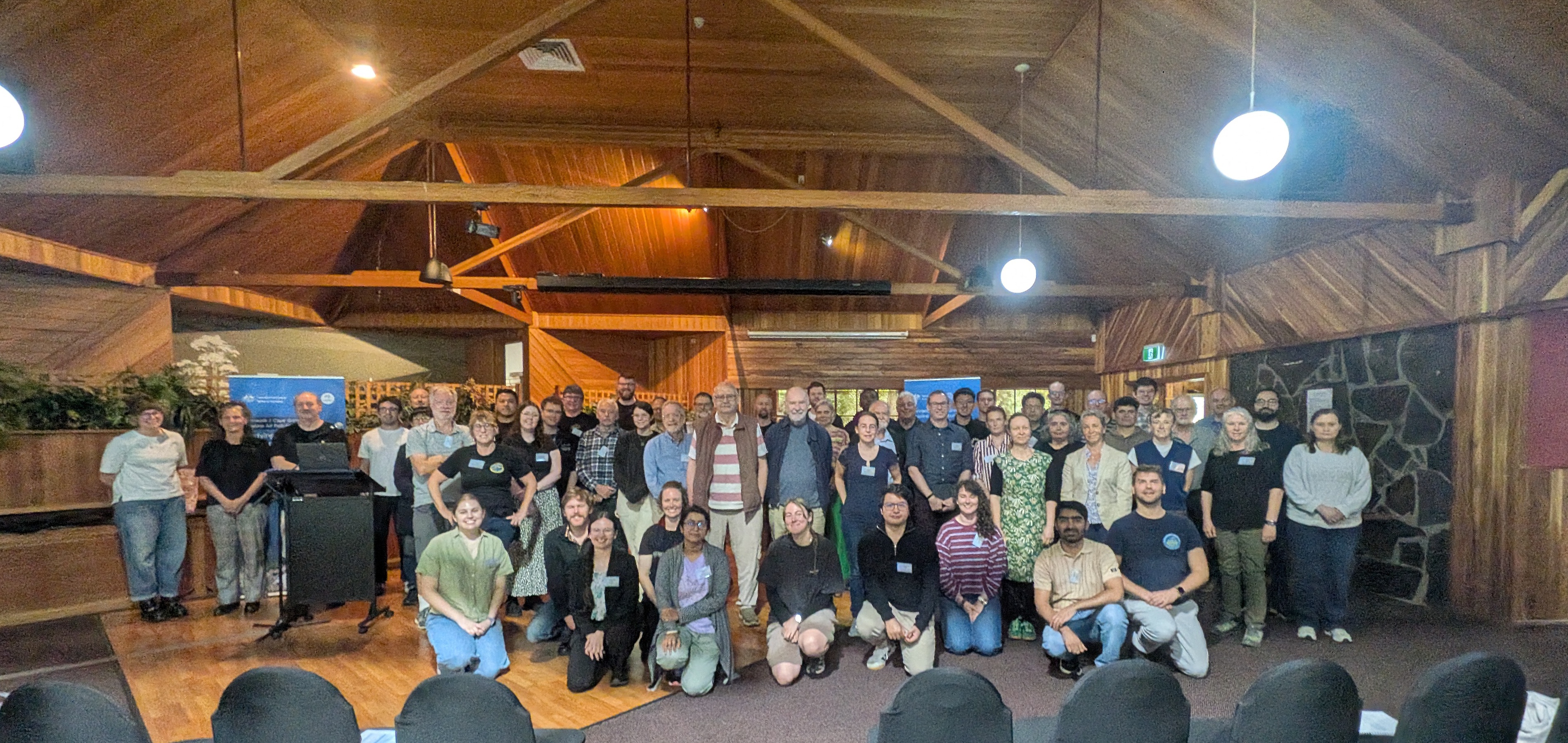
Participants of ACCOMC 2026 & the Kennaook / Cape Grim 50th Anniversary at Tall Timbers Hotel, Smithton, Tasmania (20 November 2026).
84
Registered Attendees (70 In-Person · 14 Online)
32
Organisations & 7 Countries
54
Oral Presentations (10 Sessions)
50 yrs
Kennaook / Cape Grim (1976–2026)
2026 Scientific Highlights
- 50 Years of Kennaook / Cape Grim & Law Dome Ice-Core Records: Five-decade syntheses of greenhouse gases (CO2, CH4, N2O), synthetic halocarbons, stratospheric ozone (O3) recovery, and aerosol optical depth (AOD), alongside the transition of CSIRO's Antarctic ice-core gas capability to the Institute for Marine and Antarctic Studies (IMAS) at the University of Tasmania.
- CAPE-k & Coast-k Southern Ocean Campaigns: First integrated science results from 18 months of intensive cloud, aerosol, and precipitation observations at Kennaook / Cape Grim (CAPE-k) and nearby coastal sites (Coast-k), revealing stark winter 2024 vs. 2025 boundary-layer contrasts, particle-to-gas evaporation of methanesulfonic acid (MSA), and regional cloud–aerosol modelling with ACCESS and RAL3.3.
- Atmospheric Oxidative Capacity & Methane (CH4) Flux Inversions: New emissions-free reconstructions of hydroxyl radical (OH) variability from multi-halocarbon observations, radiocarbon constraints on OH and fossil methane (14CO and 14CH4), regional CH4 emission inversions using MethaneSAT, GOES, TROPOMI, and ground-based EM27/Sun networks, and ANSTO's new portable radon calibration transfer standard (T-Rex).
- Bushfire Smoke Aging, Wine Taint & 2050 Urban Air Quality: Controlled multi-day daytime and nighttime bushfire smoke aging experiments in the SAPHIRE atmospheric simulation chamber (FZ Jülich), field measurements of toxic gas and PM2.5 emission factors from Tasmanian peat fires during the four-week ASPECT campaign, observations of smoke-taint volatile phenols (guaiacol) persisting over 200 km downwind, projections of 2050 Australian urban O3 increases driven by biogenic eucalypt emissions despite NOx cuts, emerging data-centre emissions, and a new Multiple Pollutant Air Quality Health Index.